The AI Cubs
Leopold Aschenbrenner and the professionals

"When this man touches something, it turns to gold.” Jim Cramer.
The cult of Leopold Aschenbrenner got stronger this week as the Wall Street Journal once again profiled the young man beating all the experienced investors. He isn’t the only one to ride the AI boom. But his returns, AUM, lack of previous professional experience and youth have made him one of the most talked about people in Silicon Valley – almost as many fan boys and haters as Elon Musk has.
I am always fascinated by how the hedge fund industry stretches from highly leveraged, market neutral and diversified multi-strategy firms on hand to largely long only investors like TCI and Pershing Square on the other hand. But taking concentrated bets, especially including private companies, often requires the regulatory wrapper of being called a hedge fund.
Leopold’s Situational Awareness Fund is more like a TCI or Pershing Square than a classical hedge fund. Nevertheless, it has been the fastest growing firm in the industry over the last two years. It only has 8 employees including 4 investment professionals.
As we get ready for this week’s SpaceX IPO, I look at Leopold and the other money managers investing in public equities related to the AI theme.
Just like the Gartner hype cycle of new technology innovations, financial market sentiment tends to move in cycles. April and May 2026 have been the best months for technology hedge fund investors in decades, with the average tech portfolio up by 20%.
Of course, timing is everything. Who remembers Broadcast dot com, which Yahoo acquired for $5.7 billion in stock in 1999? Yahoo shut down the business a few years later, and it is considered one of the worst Internet acquisitions ever. However, Broadcast dot com’s largest shareholder, entrepreneur Mark Cuban, managed to hedge his risk to Yahoo shares by buying puts on the Internet index and then a collar. He walked away with more than $1 billion. Cuban rode the dot-com bubble and got off before it burst. A matter of months made all the difference.
Then there is the cautionary tale of Cathie Wood’s ARK Innovation Fund or previous one hit wonders like John Paulson. As a compensation model - like many hyped money managers - both worked well but their investors suffered for a long period of time.
With Jim Cramer of CNBC singing his praises, Leopold will be hoping he can escape the inverse Cramer effect!
Prince Leopold of the Valley
The people focusing on Leopold Aschenbrenner’s lack of investing experience are missing the wood from the trees. As are those questioning how much is alpha and how much is beta. No one can produce 1000% returns over 2 years, over 250% this year and grow AUM from $100 million in July 2024 to $20 billion today (source – Wall Street Journal) without having both alpha and beta in spades.
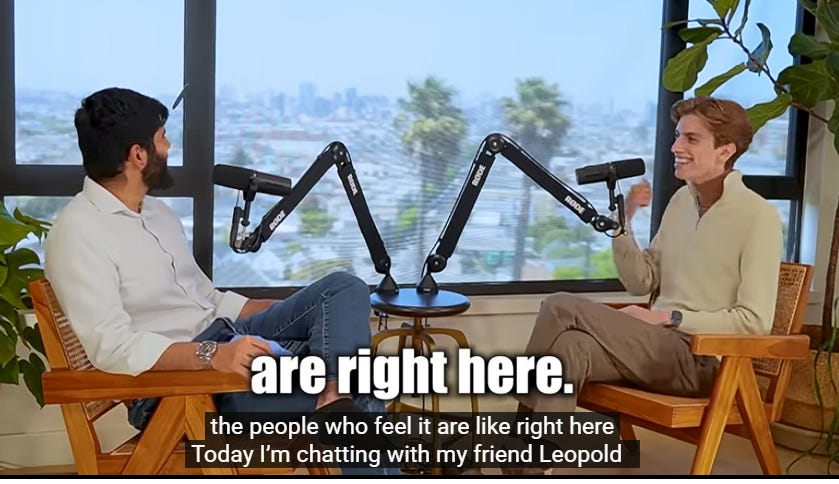
For all the Internet fan boys and trolls, the best frame of reference is Leopold’s interview with his friend Dwarkesh Patel from 2 years ago. This is just after he had raised money for his hedge fund from the likes of the Collison brothers, but before he started investing this money.
The interview is a marathon but if you listen to the start, the bit about his career or starting a hedge fund, you get what you need to know.
Leopold is clearly an exceptional individual. He started Columbia University at the mere age of 15 and did very well academically there.
He made a clear bet that AGI was coming, AI models would progress materially by 2027 and that this would create an insatiable appetite for computing power, relevant physical infrastructure and energy.
Leopold is well connected and benefited from being at the heart of the flow of information. His first job in Silicon Valley was working for the Future Fund, backed by Sam-Bankman Fried, who was a very early investor in Anthropic. Leopold then became a researcher at OpenAI.
Today, the largest single position for Leopold’s Situational Awareness Fund is $4 billion invested in Anthropic. Leopold’s fiancé is the chief of staff to Anthropic CEO Dario Amodei. Jane Street, which took over much of SBF’s Anthropic investment, is a major backer of Leopold.
Leopold starts his now famous June 2024 essay “SITUATIONAL AWARENESS: The Decade Ahead,” with the following line “You can see the future first in San Francisco.”
In summary, as Leopold tells Dwarkesh Silicon Valley is where it is happening, and you get a natural flow of ideas and information being well connected. Leopold’s friend Dwarkesh Patel is also flatmates with Dylan Patel who runs top research boutique SemiAnalysis and has a third flatmate that is an Anthropic researcher.
Leopold also talks about the importance of timing in the investments you make. His big pitch is that other companies beyond Nvidia would benefit from the boom, but he qualifies this by saying timing the revenue momentum is crucial.
As for the lack of professional experience, Ken Griffin started trading convertible bonds at Harvard University. Many great investors over time from Stanley Druckenmiller to Chris Hohn run concentrated portfolios. But Leopold’s willingness to run his winners is perhaps something a professional investor would not have done to the same extent, without checking themselves from a risk management perspective.
Moreover, the connectivity to information and fearless vision has been so much more important than grey hairs, when the backdrop has been a raging bull market.
Hedge Fund Alert wrote a week ago about Situational Awareness and another fund called Value Aligned Research advisors, both reaching $20 billion in AUM. The latter doesn’t have the star power of Leopold, but the Princeton New Jersey firm only had gross assets of $542 million a year ago, and today’s AUM is around $20 billion. Last year, the fund was 113%.
Tiger Cubs and, Cub of Cubs
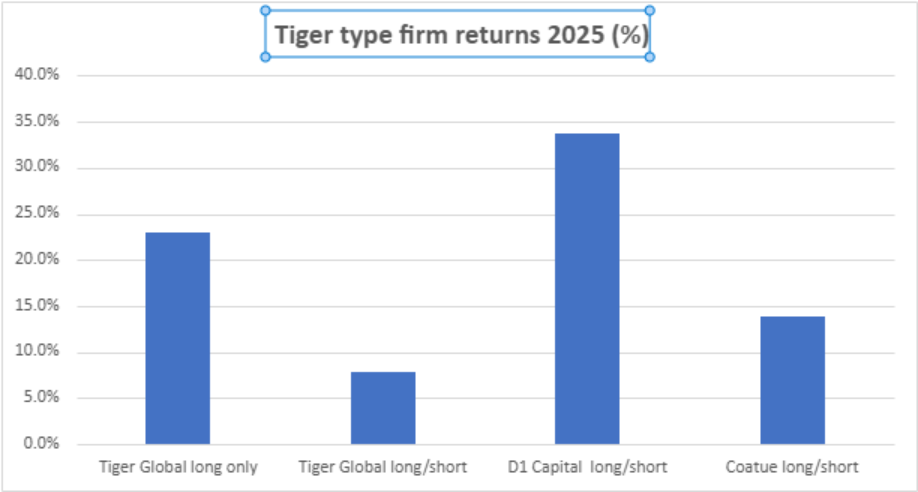
By comparison to the new entrants the returns of the large technology focused hedge funds like Coatue, Tiger Global and D1 were relatively pedestrian in 2025, especially in their public equities’ portfolios. This is notable given their huge stakes in hyperscaler and semiconductor stocks.