
Citadel pounces
Citadel buys most of the Situational Awareness public stock portfolio


“The biggest investor in our funds is my partners and myself. So, we think that you should always look for, in the hedge fund community, like, what is the alignment that you have with the GP? Are they in the asset management business? Or are they in the performance business?” Ken Griffin at GS June 2026
Its World Make Fun of Leopold Day on social media. But I wonder if the more interesting angle is really about market structure and Citadel?
The fact that Leopold was running a highly concentrated leveraged high beta portfolio that could get margin called was well known. It happened. The early investors in his fund may still have great returns (largely because of the Anthropic stake). The later ones not so much, but ask anyone who has invested with most star managers and that is not a unique situation.
The Situational Awareness prime brokers - Goldman Sachs, Bank of America and JP Morgan - were probably even more cautious or aggressive depending on which side of the table you sit on given the experience of the sector with Archegos. You may remember that was Bill Hwang’s family office that started the run on Credit Suisse. One thing that fell through the cracks at the time was that Goldman Sachs were as lucky as they were smart in that example in not taking significant losses.
Wall Street is the buyer of last resort
Silicon Valley and not Wall Street is the centre of the world we live in not just because of ideas and innovation but money. Trillion-dollar companies, huge venture capital firms and billionaire angel investors (and one former trillionaire). That is why all of us outside were surprised to see how Silicon Valley Bank went down.
The fall of Leopold’s Situational Awareness was just as quick. It made me wonder where were his friends and mentors? This was a man marrying the chief of staff of Anthropic, close friends with other Silicon Valley wonderkid favourites like podcaster Dwarkesh Patel and with anchor initial investors like the Collison Brothers. The gods of Silicon Valley had been inspired by his vision.
Citrini wrote “Imagine, for a moment, you are an LP in Situational Awareness. The fund that launched on a pitch that was essentially “AI is the only thing that matters…And you invested….because you think Leopold is uniquely situated as being one of/knowing “the few hundred people” who will bring about Machine God before 2030.
Then over the next two years, the fund did exactly what it said it would. And it went up. By, like, twenty something times if I’m remembering properly……
Now those stocks go down, so the fund goes down.
Let me ask you - do these LPs seem like the type of people that are going to become bearish on AI because SK Hynix got cut in half in six weeks?….I think it’s probable the LPs will BTFD. Situational Awareness is going to get the money they’re asking for….
I don’t think @leopoldasch is in trouble so much as he’s likely to raise the capital he’s asking for…”
But in the end it was Wall Street that stepped in. Citadel beat out Millennium and Jane Street in the auction of the bulk of the Situational Awareness’ public stock portfolio.
Even in a distressed fire sale pushed through by prime brokers this would have been a large multi-billion portfolio sale. Not only was it huge, it was a complex group of stocks to take a view on and the buyers had to move quickly with no time to do detailed deep-dives or raise financing.
In summary, the buyers had to have everything in place before the idea of the transaction came up - deep stock knowledge, risk management and financing.
When a bank becomes distressed - despite the huge number of other banks - the actual short list of potential buyers that ticks all the boxes is usually quite limited.
Often, it comes down to one firm, JP Morgan.
In a similar way, when there are fire sales of distressed public financial assets, the theoretical list of hedge funds that can take on these positions is long.
But one name - Citadel - keeps appearing just like JP Morgan.
And its leader Ken Griffin is almost as famous as Jamie Dimon.
Same movie, different era
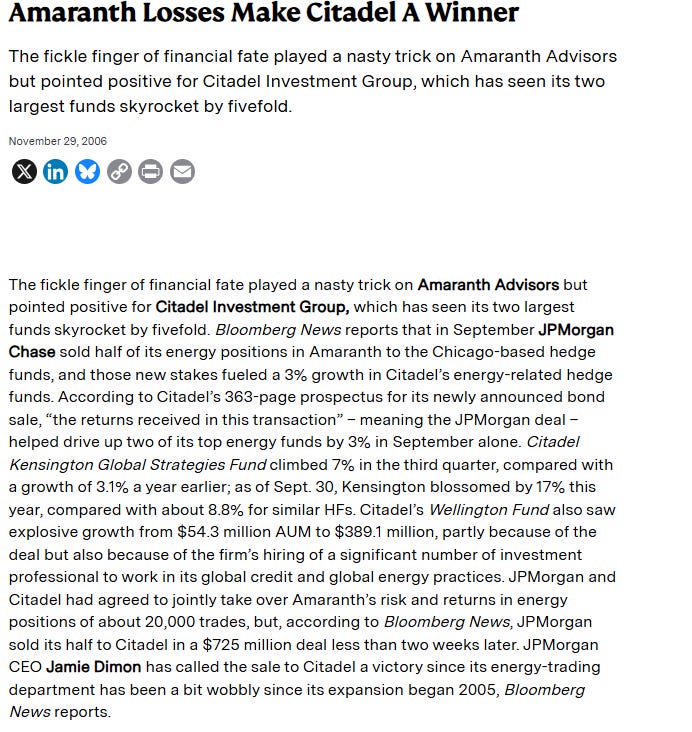
Citadel has a long history of pouncing opportunistically when other hedge funds are in distress. There are several examples like Sowood that come to mind. But it’s almost 20 years since Citadel conducted probably its most famous buy from a distressed hedge fund. Amaranth Advisors blew up on concentrated natural gas bets in September 2006. It couldn’t meet margin calls and was forced to pay (it’s clearer) JP Morgan and Citadel $2.15 billion to take on its remaining energy trades. JP Morgan sold its part of the acquired energy book to Citadel, which was a bigger winner.
The below extract from Institutional Investor Magazine at the time tells the story…
The strength of Citadel
Citadel’s overall investment returns in 2025 and H1 2026 had been mixed but its fundamental equities (discretionary stock picking) returns had been a relative bright spot. My channel checks suggest that Citadel is likely to have weathered July better than some of its peers. The combination of deep-domain knowledge, world-class risk management pedigree and financing strength allowed Citadel to move quickly.
Citadel is not centralized with a star manager like Rokos but it is not a federation of different silos like Millennium. Out of the multi-manager platforms it is by far the most centralized. PMs that don’t perform are out quickly but idea sharing is encouraged whereas it is frowned upon at Millennium. It also has a large central risk book that monitors PM positions adding to them and hedging them. Citadel has long talked about the quality and quantity of its central risk infrastructure - talent, data and capital allocation - as key differentiators.
I recently wrote about how Millennium has been growing its AUM much faster than Citadel. Bloomberg recently reported that Millennium is looking to raise another $20 billion from clients. By contrast, Citadel has been shrinking its AUM by returning tens of billions of dollars to its clients.
Citadel is from Mars and Millennium is from Venus - Part II

There are few premium brands in hedge funds or investing like Citadel or Millennium. These are platforms beyond their legendary founders. They have immense pricing power illustrated by their sky-high pass-throughs. They could both raise new money – tens of billions of dollars or more – at will, if they wanted.
But much of Millennium’s growth in terms of AUM is farmed out to external managers. Many of the larger external funds like Symmetry, WorldQuant and Taula are running high amounts of leverage given their fixed income relative value and quant strategies.
At the same time, although Citadel is well known as focusing on market-neutral alpha generation it has always run with greater risk appetite than peers. It doesn’t have the strict risk limits like Millennium. Its flagship franchise is in commodities - spanning both financial and physical trading areas - where rigid risk limits don’t work as well as in equities and fixed income. Since its inception it has delivered higher investment returns than Millennium but with greater volatility of returns.
In summary, the firm is willing to take directional bets when high conviction and not obsessed with hedging all of its exposures to markets and factors.
